
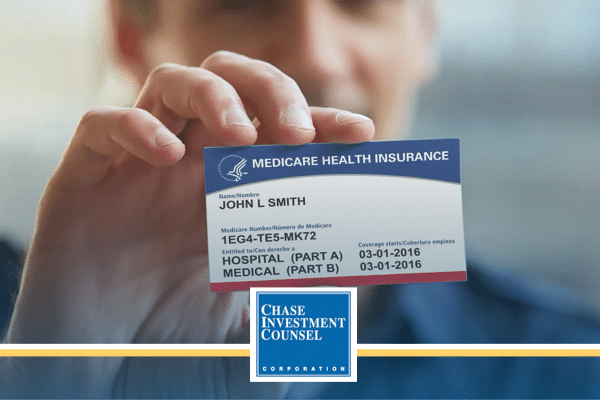
Minimizing Medicare Premiums
As you approach retirement, you will no doubt find yourself navigating a very different world than you’re used to. After years of planning and building up your retirement accounts, you’ll begin to draw them down. Instead of relying on your employer (or self) for health insurance, you’ll find yourself navigating the intricacies of Medicare. Once you look into Medicare, you’ll discover that you might have to plan for that as well, at least if you want to keep your premiums down. There are many things to consider once you begin to see how Medicare premiums are calculated.
Executive Summary
- How Medicare Premiums are Calculated
- Social Security
- Roth Conversion
- Qualified Charitable Distribution (QCD)
- How to Get Started
First, we’ll take a look at how Medicare premiums are actually calculated. Then, we’ll look at a number of different options you might want to consider in order to keep your premiums at the lowest rate (or at least lower your rate). Every option has its pros and cons, but knowing what options are available will help you to make the best decision based upon your particular situation.
How Medicare Premiums are Calculated
When you enroll in Medicare, you may be surprised to learn that not everyone pays the same rate. Instead, Medicare Part B (and D) premiums are calculated based upon your income from two years prior. That means that your initial monthly premium at age 65 is based upon your income when you were 63, and your premiums are recalculated every year. There are a number of things that can cause your income to fluctuate during retirement, including the selling of a house (while there is a $250,000 home sale exclusion for singles or $500,000 for married filing jointly, oftentimes the home will have appreciated more than that and can trigger a taxable event).
Let’s look to see how exactly Medicare premiums are calculated. Premiums are calculated based upon your Modified Adjusted Gross Income (MAGI) from two years prior. MAGI is your AGI plus tax-exempt interest. Note that this is different than your taxable income, and it doesn’t take into account things like charitable deductions. The chart below shows monthly Medicare premiums for full Part B coverage in 2026, depending upon how you file and what your MAGI is.
2026 Monthly Medicare Part B Premiums Based Upon MAGI
| Single MAGI | Joint MAGI | Monthly Premium |
|---|---|---|
| Less than or equal to $109,000 | Less than or equal to $218,000 | $202.90 |
| Between $109,000 and $137,000 | Between $218,000 and $274,000 | $284.10 |
| Between $137,000 and $171,000 | Between $274,000 and $342,000 | $405.80 |
| Between $171,000 and $205,000 | Between $342,000 and $410,000 | $527.50 |
| Between $205,000 and $500,000 | Between $410,000 and $750,000 | $649.20 |
| Greater than or equal to $500,000 | Greater than or equal to $750,000 | $689.90 |
The difference between the lowest monthly Medicare premiums and the higher rates is known as the Income-Related Monthly Adjustment Amount (IRMAA). Medicare Part D (commonly known as prescription drug coverage) also has IRMAA breakpoints, but since the base premium varies by plan, we don’t show them here. Let’s look at some strategies that you might want to consider if you are close to one of the breakpoints in order to qualify for a lower monthly Medicare premium.
Social Security
While Medicare begins at age 65, you can begin receiving Social Security payments as early as age 62. Beginning to draw from Social Security at that age will result in a permanently lower monthly benefit than if you wait until the full retirement age of 67 (for those born in 1960 or later). For each year that you delay receiving Social Security payments after the full retirement age, the monthly benefits will increase (up until age 70). Up to 85% of Social Security benefits are taxable and are included in your MAGI. So how can you use this information to your benefit when trying to reduce your IRMAA?
Planning ahead is the key, but the best option will depend upon each person’s situation. While it is generally recommended to delay receiving Social Security as long as possible (because of the reduced benefits that come with early collection), one advantage of beginning to collect early is that it reduces your income when you are 70 or older. Of course, the flip side is that it increases your income while you are on Medicare from ages 65-71. However, if you’re more concerned with avoiding the IRMAA than you are with maximizing your monthly income, there might be situations where this option would be right for you.
If you expect your MAGI to be high during your retirement years, delaying receiving Social Security payments until age 70 will help to keep your Medicare premiums lower while you are 65-71. This gives you more time to assess your financial situation as you transition from work into retirement and new life changes. Until you begin collecting Social Security, you can take some of the steps that follow in order to reduce your future MAGI and better prepare yourself to try to avoid the IRMAA.
Roth Conversion
Let’s be clear—doing a Roth conversion increases your MAGI in the year that you do it. A Roth conversion involves moving assets from a traditional IRA or 401(k) (in which taxes are deferred) to a Roth IRA. When you do that, it’s counted as income, and you have to pay taxes on the amount converted. Depending on how much you convert, it could push you into a higher bracket for purposes of calculating Medicare premiums. So why do we mention it here if we’re talking about wanting to avoid the IRMAA?
There are two potential reasons why a Roth conversion might be attractive. If you do it so that it doesn’t push you into a higher marginal income tax bracket, and don’t do so much that it pushes you into the next tier of IRMAA, then you really haven’t paid any penalty for doing it other than having to have the cash available to pay the taxes on the amount you converted.
That brings you to the possible benefits of a Roth conversion. While money in a tax-deferred account like a traditional IRA or 401(k) is subject to Required Minimum Distributions (RMDs), money in a Roth IRA is not. For those born in 1960 or later, the RMD age is 75. What that means is that you will be required to take a certain amount out of your tax-deferred account, whether you need it or not. That will be part of your MAGI, and you must take the amount or face a substantial penalty. Converting some of it to a Roth can help to lower that RMD amount.
While lowering your future RMD amount, a Roth conversion has one other key benefit. Withdrawals from a Roth IRA are tax-free and don’t count towards your MAGI. Money taken from a Roth won’t affect your IRMAA. If you want greater control over your income and how it will affect your Medicare premiums, a Roth IRA is the way to go (assuming you are willing and able to face the tax consequences when you do the conversion).
Qualified Charitable Distribution (QCD)
When your MAGI is calculated for Medicare premium purchases, it doesn’t take any charitable contributions into account. When you reach the age at which an RMD is required, it doesn’t take into account whether you need the money or not. Thankfully, there is a way to satisfy (at least part of) your RMD while meeting your charitable goals and not increasing your MAGI. It’s called a Qualified Charitable Distribution (QCD).
A QCD only applies to those who are 70½ or older, but it allows you to make a charitable distribution directly from your IRA to a qualified charity. In 2026, you can donate up to $111,000, and the amount of the QCD goes towards fulfilling your RMD. While you don’t get to deduct the charitable contribution on your income tax return, you also don’t have to report it as income (and face the possible tax consequences).
Let’s look at how a QCD might help you avoid paying higher Medicare premiums. Assume that you are 71 and a single taxpayer with an expected MAGI for the year of $108,000 before taking any money out of your IRA. If your RMD is calculated to be $30,000, that would bump your monthly Medicare premium (two years down the road) from $202.90/month to $405.80/month. Taking your $30,000 RMD would double your Medicare premium. However, if you took that $30,000 as a QCD, your Medicare premiums would stay in the lowest bracket, and the qualified charity of your choice would receive the $30,000 benefit.
It’s worth noting that a QCD could be combined with a Roth conversion. For instance, an $80,000 QCD (instead of just a regular withdrawal) combined with an $80,000 Roth conversion would result in no increase to your MAGI, assuming you make no additional IRA withdrawals, but it would position you to take advantage of the Roth benefits that we mentioned earlier.
How to Get Started
As you transition to retirement, you will face a myriad of changes as you navigate government programs and the tax code. Consult with a trusted financial professional to help walk you through the best way to prepare for retirement and the new challenges you’ll face. When done properly, you can help preserve wealth and prepare for a more secure financial future.
About Chase Investment Counsel
Chase Investment Counsel is a family and employee-owned boutique wealth management firm that offers personalized investment services. Our clients include career professionals, those nearing or in retirement, and families experiencing financial transitions such as generational wealth transfer, widowhood, divorce, or sale of a business. Chase’s active, disciplined investment management team is focused on selecting individual stocks and bonds targeted to each investor’s specific financial goals and risk tolerance. Established in 1957 in Charlottesville, VA, Chase Investment Counsel manages more than $500 million in assets as of December 31, 2025.
Chase Investment Counsel Corporation
350 Old Ivy Way, Suite 100
Charlottesville, VA 22903-4897
Direct: 434.293.9104
Shareholder Services: 888.861.7556
© 2026 Chase Investment Counsel Corporation